There is a huge deficit in the demand and supply of well-qualified Electrical Engineers in the country. With this view the Electrical Department was started. The department has following fully equipped laboratories of Electrical Engineering
Research and specialization can be carried out in any of the following fields:
• Circuit Analysis
• Electro-Magnetism
• Solid-State Electronics
• Electric Machines
• Electric Power Systems
• Digital Logic Circuits
• Computer Systems
• Communication Systems

| Course level | Graduate |
|---|---|
| Duration | 4 Years |
| Average Salary Package | INR 3,75,000 |
| Highest Salary Package | INR 5,00,000 |
| Examination Type | Semester System |
| Program Eligibility | 10+2 or equivalent with a minimum of 45% marks |
| Top Recruiting Organizations | Secure Meters, Alpha-Numero, Pinnacle Infotech, VVDN Technologies Pvt Ltd, Luminous Power Technologies Pvt. Ltd. & many more |
To deliver an exceptional educational experience, grounded in top-tier teaching and learning practices, leading students towards diverse career paths within the dynamic field of electrical engineering. Our vision extends beyond traditional domains, embracing emerging areas such as renewable energy, smart grids, and advanced electronics.
· To provide effective learning ambiance to gain an excellent skill set to pursue a wide range of careers in the changing and challenging technological world.
· To help obtain wide-reaching technical skills and knowledge of latest technologies.
· To facilitate burgeoning researchers in the emerging areas of the discipline.
Program Educational Outcomes (PEOs) for Electrical Engineering are overarching statements that describe the expected accomplishments and skills that students should achieve by the time they complete their academic program. PEOs are designed to align with the mission and goals of the educational institution and to assess the effectiveness of the Electrical Engineering program. While specific PEOs may vary among institutions, here is a general list of common Program Educational Outcomes for Electrical Engineering:
Successful Careers: Graduates should have successful and fulfilling careers in electrical engineering or related fields, demonstrating competence, adaptability, and leadership.
Advanced Education: Graduates should pursue advanced education, such as postgraduate studies, research, or professional development, to enhance their knowledge and skills in electrical engineering.
Engineering Knowledge: Graduates should demonstrate a solid understanding of the fundamental principles, theories, and concepts in electrical engineering.
Problem Analysis and Solution Design: Graduates should be able to analyze complex engineering problems, identify requirements, and design and implement solutions using appropriate engineering tools and techniques.
Conduct Investigations and Research: Graduates should be capable of conducting research, utilizing modern engineering tools, and applying their knowledge to solve problems in electrical engineering.
Teamwork and Communication: Graduates should be able to work effectively in multidisciplinary teams, communicating technical concepts to diverse audiences.
Ethical and Professional Responsibility: Graduates should adhere to ethical standards and demonstrate professional responsibility in their engineering practice, considering the impact on individuals and society.
Lifelong Learning: Graduates should recognize the importance of staying current with emerging trends, technologies, and methodologies in electrical engineering throughout their careers.
Global and Societal Impact: Graduates should be aware of the global and societal impact of electrical engineering solutions, considering factors such as cultural diversity, environmental sustainability, and social responsibility.
Entrepreneurship and Innovation: Graduates should demonstrate an entrepreneurial mindset and the ability to innovate, possibly by creating new products, services, or solutions in the field of electrical engineering.
Leadership and Management Skills: Graduates should exhibit leadership and management skills, potentially taking on roles that involve leading teams, projects, or initiatives within the field.
Program Specific Outcomes (PSOs) for Electrical Engineering are specific statements that describe the expected knowledge, skills, and attributes that students should acquire by the time they complete their academic program. PSOs are more focused and detailed than Program Educational Outcomes (PEOs), tailoring the outcomes to the specific discipline. While specific PSOs may vary among institutions, here is a general list of common Program Specific Outcomes for Electrical Engineering:
Engineering Analysis: Graduates should be able to apply engineering principles to analyze and solve complex electrical engineering problems.
Design and Implementation: Graduates should be capable of designing and implementing electrical systems, components, or processes that meet specified requirements, considering economic, environmental, social, ethical, and safety factors.
Experiments and Data Analysis: Graduates should be proficient in conducting experiments, analyzing data, and interpreting results to draw conclusions related to electrical engineering phenomena.
Use of Modern Tools: Graduates should be familiar with and able to use modern tools, software, and equipment relevant to electrical engineering practice.
Teamwork and Communication: Graduates should be able to work effectively as part of a team, understanding team dynamics and contributing to the success of group projects. They should also possess effective communication skills.
Problem-Solving with Sustainability: Graduates should be able to apply knowledge of contemporary issues, including sustainability, in solving electrical engineering problems.
Professional and Ethical Responsibility: Graduates should adhere to ethical standards and demonstrate professional responsibility in their electrical engineering practice.
Lifelong Learning: Graduates should recognize the importance of continuous learning, staying abreast of emerging technologies and evolving trends in electrical engineering throughout their careers.
Environmental and Societal Impact: Graduates should be aware of the environmental and societal impacts of electrical engineering solutions, considering factors such as cultural diversity, environmental sustainability, and social responsibility.
Project Management: Graduates should understand and apply project management principles in the execution of electrical engineering projects.
Entrepreneurship and Innovation: Graduates should demonstrate an entrepreneurial mindset and the ability to innovate, possibly by creating new products, services, or solutions in the field of electrical engineering.
Program Outcomes (POs) for Electrical Engineering are specific statements that describe the knowledge, skills, and attributes that students are expected to acquire by the time they complete their academic program. These outcomes serve as benchmarks for the overall success of the Electrical Engineering program and are designed to align with the mission and goals of the educational institution. While specific POs may vary among institutions, here is a general list of common Program Outcomes for Electrical Engineering:
Engineering Knowledge: Graduates should demonstrate a solid understanding of the fundamental principles, theories, and concepts in electrical engineering.
Problem Analysis: Graduates should be able to analyze complex electrical engineering problems using appropriate mathematical and scientific principles.
Design/Development of Solutions: Graduates should possess the ability to design and implement solutions to electrical engineering problems, considering system requirements, constraints, and safety factors.
Conduct Investigations of Complex Problems: Graduates should be able to conduct research and investigations related to electrical engineering issues, employing analytical and experimental techniques.
Modern Tool Usage: Graduates should be proficient in using modern engineering tools, software, and equipment to analyze and solve electrical engineering problems.
Individual and Teamwork: Graduates should be capable of working effectively as individuals and as part of multidisciplinary teams, understanding the dynamics of teamwork.
Communication Skills: Graduates should be able to communicate effectively, both in written and oral forms, presenting technical information to diverse audiences.
Ethics and Professional Responsibility: Graduates should adhere to ethical standards and demonstrate professional responsibility in their engineering practice.
Life-long Learning: Graduates should recognize the importance of continuous learning and engage in professional development activities to stay abreast of emerging technologies in electrical engineering.
Global and Societal Impact: Graduates should be aware of the global and societal impact of electrical engineering solutions, considering cultural diversity, environmental sustainability, and social responsibility.
Entrepreneurship and Innovation: Graduates should demonstrate an entrepreneurial mindset and the ability to innovate, possibly by creating new products, services, or solutions in the field of electrical engineering.
Leadership and Management Skills: Graduates should exhibit leadership and management skills, potentially taking on roles that involve leading teams, projects, or initiatives within the field.
Electrical engineering is a broad and versatile field with numerous benefits and opportunities for individuals pursuing a career in this domain. Here are some key branch benefits of electrical engineering:
Versatility and Breadth: Electrical engineering spans a wide range of applications, including power systems, electronics, telecommunications, control systems, and signal processing. This versatility allows professionals to work in diverse industries and contribute to various technological advancements.
High Demand: There is a consistently high demand for electrical engineers globally. Industries such as energy, telecommunications, manufacturing, and electronics rely on electrical engineers to design, implement, and maintain systems critical to their operations.
Innovation and Technology Advancements: Electrical engineers play a crucial role in driving technological innovation. They are involved in developing cutting-edge technologies, improving existing systems, and contributing to advancements in areas like renewable energy, artificial intelligence, and smart devices.
Global Opportunities: The skills acquired in electrical engineering are transferable globally, allowing professionals to work on international projects and collaborate with experts from around the world.
Impact on Renewable Energy: Electrical engineers contribute significantly to the development and implementation of renewable energy sources, such as solar and wind power. They play a key role in addressing global challenges related to sustainability and environmental conservation.
Telecommunications and Networking: With the growth of communication technologies, electrical engineers are essential for designing and optimizing telecommunication networks, ensuring efficient data transmission and connectivity.
Career Diversity: Electrical engineers can choose from various specializations, including power systems, control systems, electronics, telecommunications, and computer engineering. This diversity allows professionals to tailor their careers to their interests and strengths.
Job Security: The essential role of electrical engineers in critical sectors such as energy, telecommunications, and technology contributes to job security. The demand for electrical engineering expertise is expected to remain strong.
High-Paying Jobs: Electrical engineering is often associated with competitive salaries, reflecting the high demand for specialized skills in areas like power systems, control systems, and telecommunications.
Influence on Infrastructure: Electrical engineers contribute to the design and maintenance of essential infrastructure, including power grids, transportation systems, and communication networks, playing a vital role in societal development.
Continuous Learning: The dynamic nature of technology requires electrical engineers to engage in continuous learning. This keeps professionals updated on the latest advancements and encourages a mindset of lifelong learning.
Entrepreneurial Opportunities: Electrical engineers with innovative ideas can pursue entrepreneurial ventures, creating their own startups or contributing to the development of new technologies and solutions.

“The faculty members at CLGIET are highly knowledgeable and always supportive. They guided us not just in academics, but also in projects, internships, and technical paper presentations. With advanced lab facilities and a strong learning environment, I feel well-prepared for a successful civil engineering career.”

“CLGIET’s CSE department helped me bridge the gap between academics and the tech industry. Through workshops, internships, and skill-based training in Python, Java, and Data Science, I developed a strong profile. With the help of the Training & Placement Cell, I secured a job offer from a reputed IT company before graduation.”
_1750412622.jpg)
“Pursuing CSE at CLGIET has been a transformative journey. The curriculum is well-structured, industry-relevant, and supported by experienced faculty. From classroom learning to hands-on labs and coding events like Byte Battle, I gained both theoretical and practical skills. The supportive environment and focus on innovation shaped me into a confident professional ready for the tech world.”

I am glad to share that our college is good in academics as well as extracurricular activities which help us to build self confidence and personality. It's a ocean of knowledge and experiences for students over there. The favorable learning environment and extracurricular activities helped me to be more confident to face the industry. With all these knowledge I got selected in Zuventus Healthcare Ltd. as Marketing Executive.

CLGIET proves to be a pool of opportunities for every student who is willing enough to chase down their dreams. It not just provides you with various platforms to showcase your abilities and skill but also helps you to learn all soft skills that are highly required. You get training on interview skills, communication skills, life skills, and effective time management many more.

I have been absolutely thankful and overwhelmed with the positivity, opportunities and overall education University programs and its instructors have offered me. CLGIET has granted me the tools, motivation and information to follow and establish my dream. The university offers dozens of activities, clubs and amenities in order to keep students active on campus.

_1763545349.png)
1. Objectives To formally welcome the newly appointed Director, Dr. Prashant Vitthal Kadam, and De ...

Date: 17 November 2025 Venue: CLG Campus, Sumerpur Organized by: CLG Group of Institutions CLG Grou ...
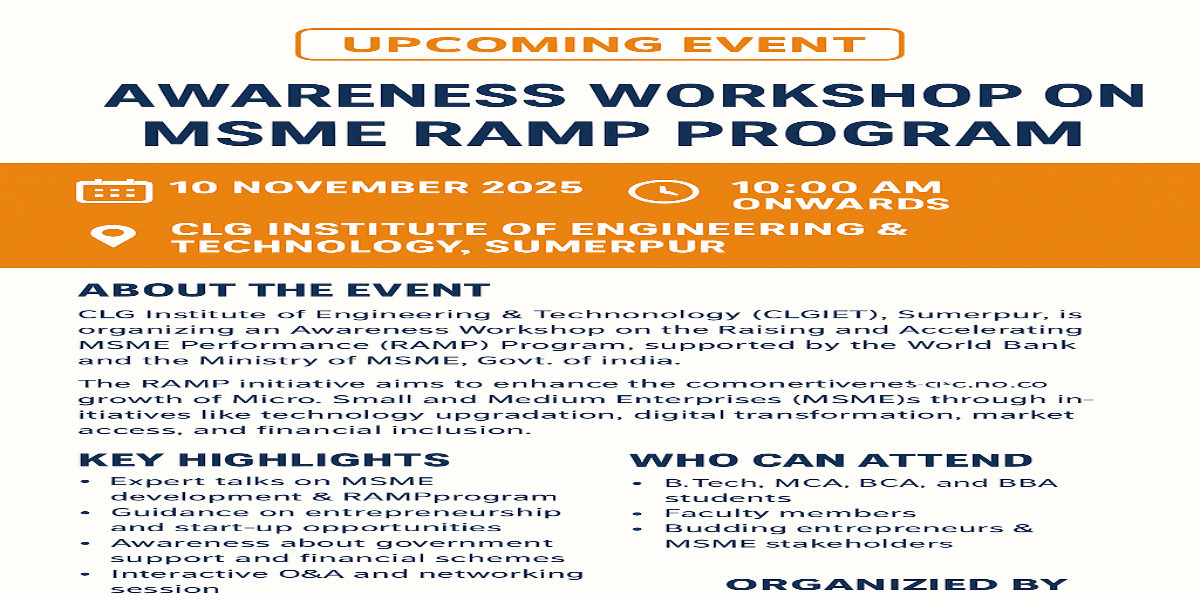
📅 Date: 10 November 2025 🏛️ Venue: CLG Institute of Engineering & Technology, Sumerpur 🕘 Tim ...

CLG Institute of Engineering & Technology, Sumerpur, in association with Genus Power Infrastruct ...
_1761554814.jpg)
The CLG Institute of Engineering & Technology (CLGIET), Sumerpur, in association with the Board ...
_(1)_1750412153_1750997874.jpg)
Grand Musical Night – सोऽहम् 2025 Date: 15th June 2025Venue: CLG Group of Institutions, Sumer ...